19/10/2026 12:20
What Happens After Start? A Telegram Bot Enquiry Workflow for Cambodian Laundry Shops

A laundry promotion can explain a useful service and still leave customers uncertain about their next step. Someone taps the Telegram bot link, sees Start, and expects help with collection areas, garment types or turnaround. If the bot returns an empty greeting or an endless menu, the promotion has created another obstacle. For Cambodian laundry businesses considering SMM services, the practical question is what the bot does after that first interaction. This workflow uses a hypothetical Phnom Penh laundry shop to plan a small enquiry assistant, connect promotional messages to useful answers, and keep bot activity separate from actual bookings.
1. Decide whether a bot solves a recurring problem
Start by reading the questions staff already answer. A bot is worth considering when customers repeatedly need stable information, such as accepted laundry categories, collection arrangements or the process for requesting a quote. If most conversations involve unusual fabrics, disputed charges or changing delivery arrangements, direct staff contact may be the better starting point. Automation should remove a predictable delay.
In our hypothetical shop, customers often ask whether collection is available in their neighborhood before describing their laundry. The proposed bot helps them check the service area and request staff assistance. It does not diagnose stains, promise successful cleaning or reserve a driver automatically. Write that boundary into the brief so the developer, counter staff and person preparing promotions share the same expectation.
2. Separate a bot account from a working enquiry service
Telegram explains that bots connect to an owner’s server, which processes incoming requests. Registering a bot account therefore does not supply a finished laundry assistant. Someone must implement the replies, maintain the service information and handle failures. Telegram also states that a bot cannot initiate a conversation with a user; the user must first message it or add it to a group. These platform basics are documented in Telegram’s introduction for developers.
Before commissioning work, name an operational owner and a technical contact. Ask who updates collection coverage, who notices when replies stop, and how the shop can suspend promotion during an outage. Keep control credentials separate from public links. Telegram warns that possession of the bot token gives control over the bot; a marketing collaborator should normally need the public destination, not that token.
3. Design a small menu around customer decisions
Sketch the conversation on paper before choosing buttons. For the hypothetical laundry, three opening choices are enough: understand laundry services, check collection coverage, or ask staff. Each path should answer something useful before requesting more information. A customer browsing prices should not have to provide a home address just to learn how the shop calculates a quote.
Offer Khmer and English if the shop can maintain both versions accurately. Let customers choose rather than treating an app language as proof of their preferred language. Keep equivalent choices in the same order. Telegram supports bot commands and custom keyboards, but the particular menu and language behavior must be implemented. Include a clear return to the main menu and an escape to staff whenever a scripted answer may be insufficient.
4. Make the welcome explain what happens next
A useful welcome identifies the business, explains that the reply is automated and names the available help. For example, the hypothetical shop could say: “This is our laundry enquiry assistant. Check services or collection coverage below. A team member must confirm collection arrangements.” The distinction prevents a customer from treating a successful button press as an accepted booking.
Show the staff response window using actual shop hours and Cambodia time. Avoid promising immediate human help unless someone is assigned to provide it. If a request can be queued, explain that it has been received and remains unconfirmed. Have staff review the wording on a small phone: the customer should understand the next action without reading a long introduction or guessing what an unfamiliar icon means.
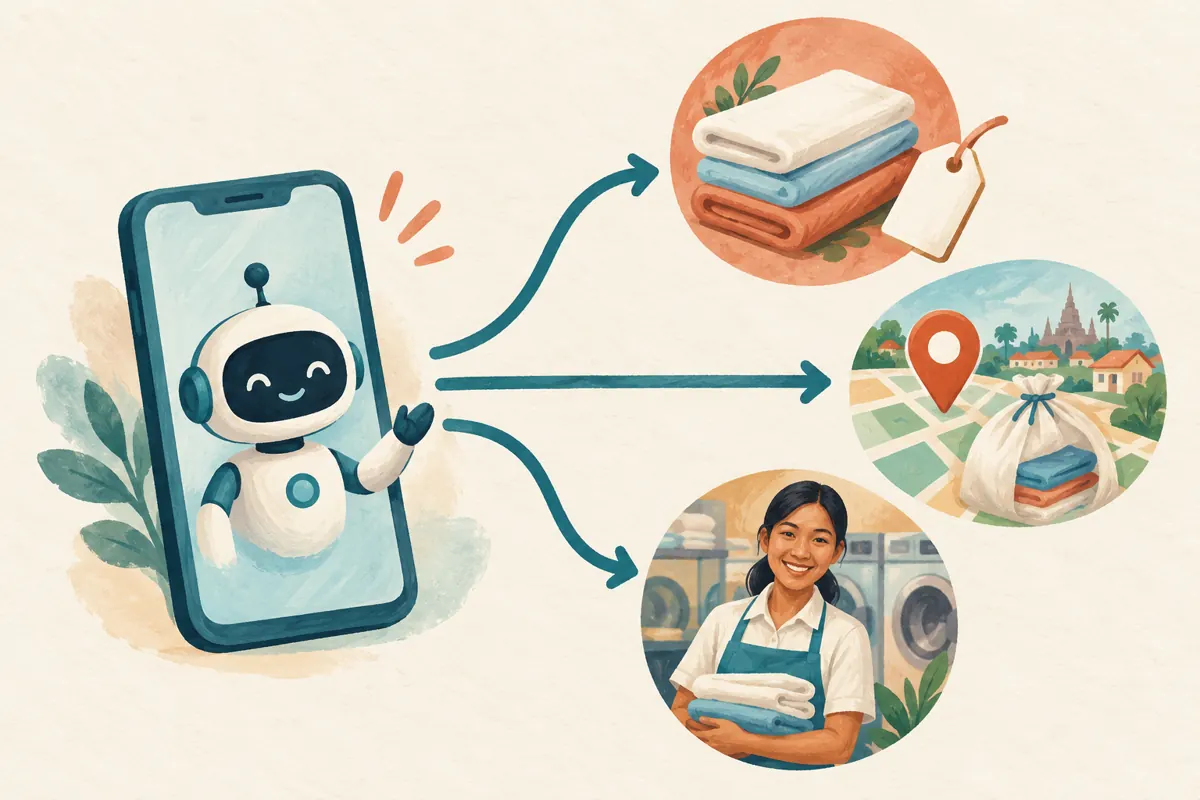
5. Connect each promotion to an appropriate entry point
Telegram’s deep-linking feature lets a bot link carry a start parameter. A developer can use that value to select an opening response or record a campaign label. For this hypothetical shop, a post about blanket cleaning might use the label blanket_post, while a counter display might use counter_card. These are illustrative labels, not working links or built-in Telegram campaign reports.
Ask the developer to keep labels short and nonsensitive, and to provide a safe default when a label is missing or unrecognized. The promotion should explain the destination: “Open our Telegram assistant to check collection coverage.” A shared link may travel beyond its original placement, so its label identifies the link used rather than proving exactly where a person discovered the business. Treat it as context, not complete attribution.
6. Collect only what staff need for the next answer
For an initial collection enquiry, a neighborhood and broad laundry category may be enough. Request the exact address only when staff need it to arrange service. Avoid asking for identity documents, payment credentials or unrelated personal details. If a garment photograph would help, explain its purpose and ask the customer to keep faces, delivery labels and household documents outside the frame.
Telegram’s privacy policy explains that interacting with bots sends information to their third-party operators, including messages and some public account data. Tell customers who operates the shop’s assistant and how to reach staff about their information. Agree with the technical provider which records are retained, who can access them and when they are removed. Do not promise that deleting a Telegram conversation also deletes every separately stored business record.
7. Build a real handoff to a person
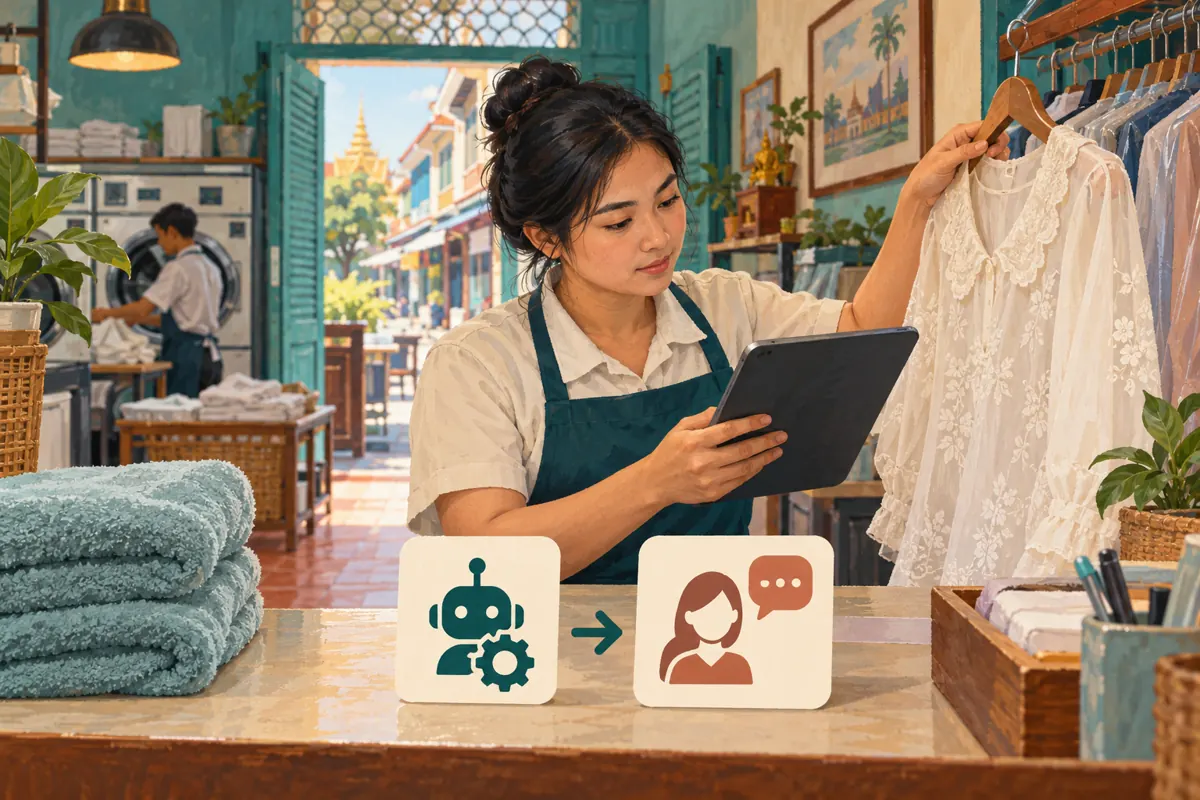
A button labeled “Ask staff” is useful only if it reaches a monitored destination or creates a request someone can retrieve. Have the developer demonstrate the complete path. If the button opens a separate staff chat, explain that transition and tell customers what context to include. If messages remain inside the bot, staff need an implemented way to read and answer them.
For the hypothetical shop, a delicate blouse requires staff review. The handoff summary should preserve the selected language, garment category and question so the customer does not repeat everything. The employee then checks whether inspection is required before quoting. Acknowledgement, quotation and collection confirmation should have different wording. Name a backup employee for absences and establish what happens when a request remains unanswered at closing time.
8. Test the awkward journeys before promoting
Ask consenting staff or testers to try realistic tasks on their own devices. Include someone who has never opened the bot and someone returning to it. Test the plain bot link, each promotional link, language changes, repeated Start commands and requests outside the collection area. Also send an unexpected message instead of selecting a button. The response should help the user recover or reach staff.
Record the expected answer, observed answer and correction needed for each task. Check whether restarting accidentally creates another collection request, and whether returning customers receive outdated information. Test the failure path with the technical provider rather than assuming the system is always available. These checks establish functional readiness. Purchasing start events cannot replace a person verifying that the correct answer appeared and the staff handoff actually worked.
9. Evaluate the listed bot-start service against the objective
The supplied jkj-smm.com catalogue includes “Telegram Bot Start ~ Max 1M ~ 50k/Days ~ INSTANT”. Its name identifies it as a bot-start offering, but the supplied description is empty. The quantities and timing in that title are catalogue claims, not independently verified performance. Nothing supplied establishes Cambodian audience origin, genuine interest, completed enquiries or booking outcomes.
If the objective is to learn whether local residents want laundry collection, purchased starts cannot answer it. They also do not establish sales, official advertising delivery or a Telegram affiliation. Before considering any order, request documented clarification of the target format, what constitutes delivery and applicable conditions. Check the proposed use against Telegram’s current rules. When the business needs local enquiries, first improve the customer journey and promote it transparently to people who may need the service.
10. Review conversations without turning starts into customers
Define separate events: a start interaction, a meaningful enquiry, a staff-reviewed request and a confirmed arrangement. Decide how repeated interactions will be handled before comparing totals. A person returning to check coverage should not silently become another new customer. Keep staff tests and any purchased activity identifiable in the records wherever the implementation allows, and disclose uncertainty when they cannot be separated.
For the hypothetical laundry, a useful weekly review asks where customers became confused, which coverage questions needed manual answers and whether staff followed up. Confirm bookings against the shop’s operational records. If many people stop after reading a clear answer, that may mean their question was resolved; it does not automatically mean the bot failed. Investigate the conversation context before changing the promotion or buying more activity.

Frequently asked questions
Can a small laundry shop use a bot without a full booking system?
Yes. A limited assistant can explain services and help customers reach staff, provided those functions are implemented and maintained. State clearly that collection requests require human confirmation. Begin with the narrowest useful workflow, then add functions only when staff can support them. A simple, accurate information service is easier to maintain than an unfinished automated booking process.
Does a customer need to share a phone number immediately?
Design the first questions around the answer the customer needs. A coverage check may require only a neighborhood. If a phone number becomes necessary for collection coordination, explain why and request it at that stage. Do not treat starting the bot as agreement to supply every personal detail or receive unrelated promotional messages.
Can a campaign label prove that a particular post caused a booking?
It can provide useful context when the bot records it correctly, but the link may have been forwarded or revisited. Compare the label with the conversation and confirmed booking record. Report it as the entry link observed, and avoid claiming exclusive credit when the customer may have encountered several promotions.
What if customers type messages instead of choosing buttons?
Plan that behavior explicitly with the developer. The assistant should give a helpful fallback or route the message to staff, rather than silently ignoring it. Test Khmer, English and mixed-language enquiries with consenting testers. Do not claim that the bot understands arbitrary messages unless its actual implementation has been verified for those situations.
Should purchased bot starts be included in a local demand report?
They should not be presented as evidence of local demand. Record any purchased activity separately from voluntarily submitted customer enquiries and verified bookings. If the records cannot distinguish the sources reliably, explain that limitation. A service delivery record may support an order discussion, but it does not establish that Cambodian customers wanted laundry collection.
Explore the current service catalogue, create an account, or ask a specific question through support tickets.
- Telegram — Bots: An introduction for developers
- Telegram Bot Features — Commands, keyboards and deep linking
- Telegram Privacy Policy — Bot messages and data
- Telegram Bots FAQ — Creating and operating a bot
Prepared with AI assistance. Illustrations explain the workflow and do not represent customer results.